


Why the Best SAP S/4HANA Public Cloud Implementations Start with Letting Go
Every organization believes its processes are unique. Ask any department head and they will tell you the same thing — “our business is different.”
And in some ways, that is true.
But when it comes to ERP implementation, that belief is also the single most expensive assumption a company can make.
Fit to Standard is the principle at the heart of every successful SAP S/4HANA Public Cloud implementation. It means adopting SAP’s built-in business processes — designed from decades of industry experience rather than bending the system to mirror what you have always done.
SAP S/4HANA Public Cloud is not a generic platform waiting to be configured from scratch. It comes pre-configure with best-practice processes spanning finance, procurement, supply chain, human resources, and more. These processes were shaped by thousands of enterprise implementations across every major industry. When you adopt them, you are not settling. You are inheriting the operational intelligence of the world’s leading enterprises.
How Fit-to-Standard Works
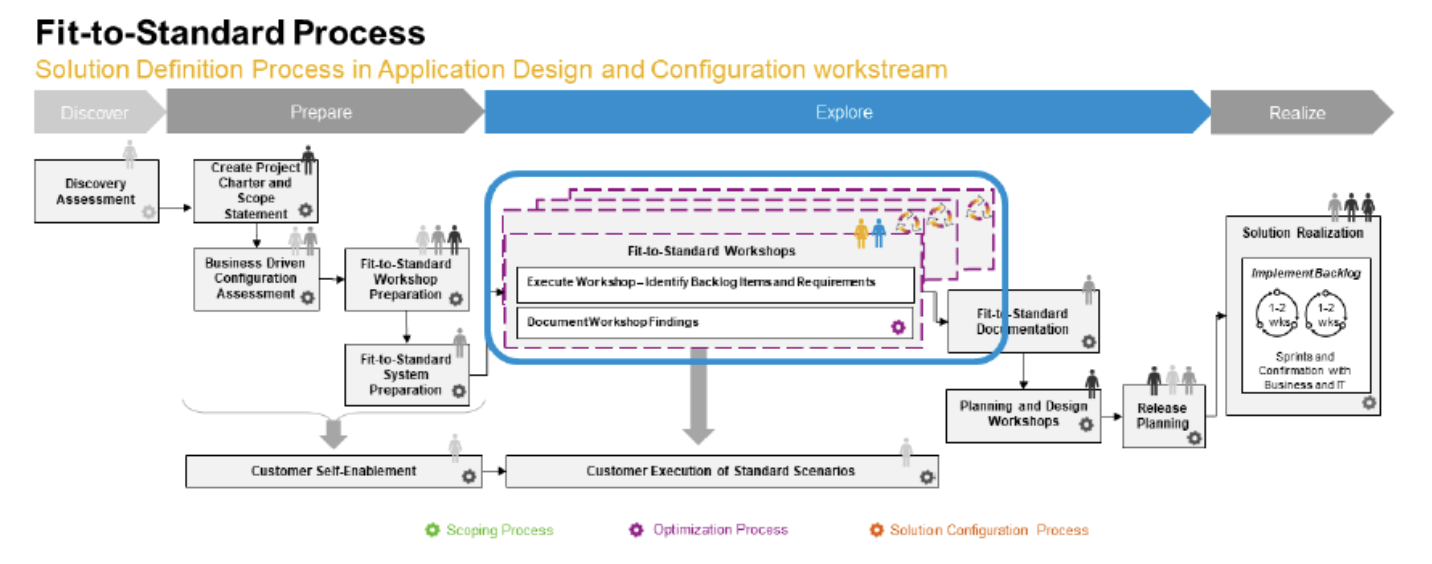
The concept is not theoretical, it is executed through a structured, workshop-driven cycle within SAP S/4HANA Public Cloud designed to validate standard processes before any changes are considered.
- Review Best Practice Process Flow
The workshop begins with SAP Best Practices. The configuration expert walks through the standard end-to-end process to establish a clear baseline of how the system is designed to operate.
- Demonstrate Scope Items and Concepts
Key scope items are demonstrated, showing actual system behavior and transactions. This gives business users a concrete view of how processes execute in real time.
- Fit-to-Standard Discussion
The team evaluates how these standard processes align with business requirements. This is where alignment is validated not assumed using the Business-Driven Configuration Questionnaire as reference.
- Identify Delta Requirements
Any gaps between standard functionality and business needs are captured as Delta Requirements. These are documented for further analysis rather than immediately customized.
- Identify Required Configuration
Required configuration values and adjustments are defined to align the system with business needs without deviating from standard wherever possible.
- Enable Customer Execution of Standard Scenarios
The customer executes validated scenarios in the system. This ensures the process works in practice, not just in theory, and confirms readiness for adoption.
Why Rejecting the Standard is Costly
- Every deviation from standard has a compounding effect
- Longer implementation timelines
- Increased project costs
- Higher system complexity
- Upgrade limitations
Customization creates dependencies.
Dependencies introduce fragility.
And over time, that fragility becomes technical debt that quietly drains resources.
Leadership Makes the Difference
The most successful CIOs and IT leaders understand one thing early:
Fit to Standard is not a system decision, it is a business decision.
They:
- Align stakeholders upfront
- Set expectations early
- Position the project as transformation and not replication
This mindset eliminates resistance and accelerates adoption as they treat the implementation as an opportunity to modernize operations not just replace software.
Letting Go is the Real Advantage
Letting go of legacy processes is not a loss. It is the starting point of real transformation.
Organizations that embrace Fit to Standard:
- Go live faster
- Operate more efficiently
- Continuously innovate through SAP’s quarterly updates
No major upgrades. No disruption. Just continuous improvement.
The Bottom Line
Fit to Standard is not about limitation, it is about discipline.
In SAP S/4HANA Public Cloud, the organizations that succeed are not the ones that try to recreate the past. They are the ones that make deliberate choices to simplify, standardize, and move forward.
Because the real value of SAP S/4HANA Public Cloud is in the operating model it enables. A model that is scalable, continuously improving, and built to adapt as your business evolves.
The question is no longer “How do we make the system fit us?”
It is “Are we ready to operate at the level the system is designed for?”
That shift in mindset is what separates a system implementation from a true business transformation.