

If you run SAP in the Philippines, here is a sentence nobody at your SAP demo said out loud:
Your SAP subscription does not make you BIR-compliant.
Not RISE. Not GROW. Not S/4HANA. Not Business One. Not the ECC system you have been running for twelve years.
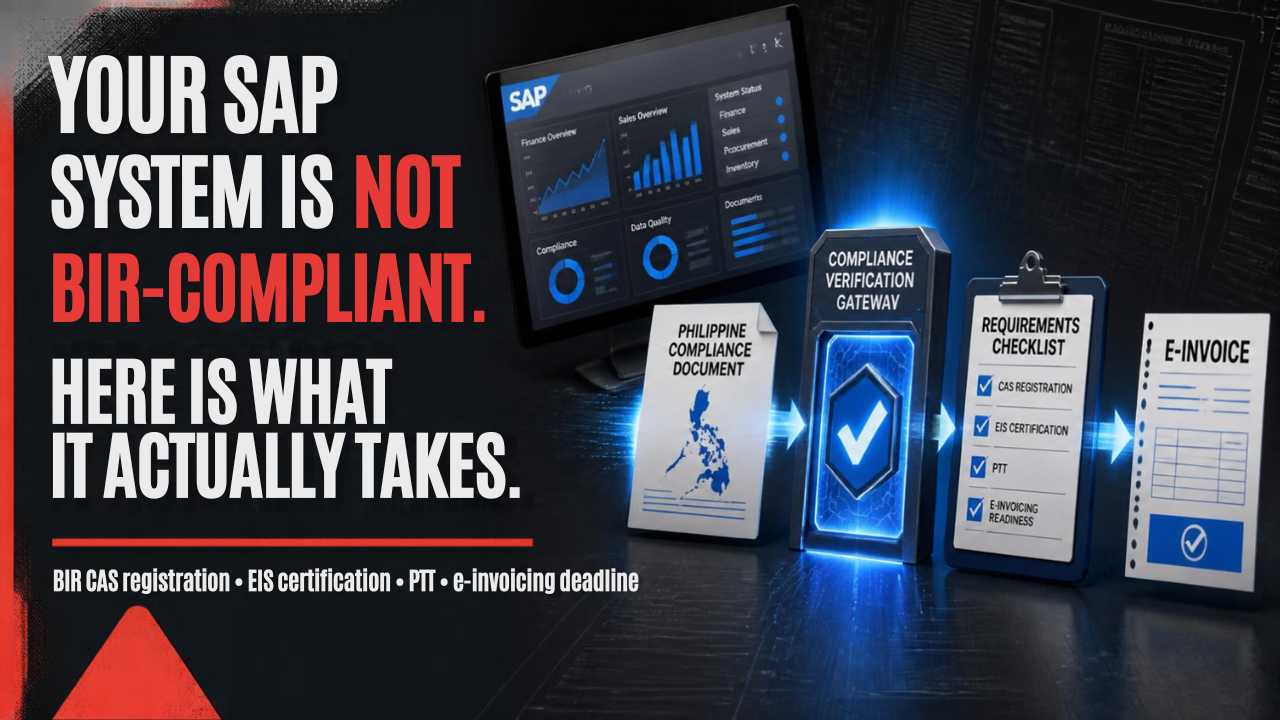
SAP gives you the platform. The BIR wants something else entirely: a registered Computerized Accounting System, a certified e-invoicing pipeline, a Permit to Transmit, and ten years of audit-ready records. None of those ships in the box. All of it is implementation work. And most of it has a hard deadline of December 31, 2026.
This article explains exactly what is required, what it costs you if you get it wrong, and what Byte Sense does to make your SAP estate BIR-proof.
The two deadlines nobody is treating as deadlines
December 31, 2026. Under Revenue Regulations No. 11-2025, as extended by RR No. 26-2025, covered taxpayers must be able to issue structured electronic invoices and be certified on the BIR’s Electronic Invoicing System (EIS). Covered means large taxpayers, e-commerce and internet-transaction businesses, exporters and incentive-registered enterprises, and any business using a Computerized Accounting System with an invoicing module. If you are running SAP and issuing invoices out of it, read that last category again.
December 31, 2027. SAP ends mainstream maintenance for ECC. If you are still on ECC, you are migrating to S/4HANA within roughly 15 months. And under RMO No. 9-2021, that migration is a “major system change” that requires a brand-new BIR CAS registration. Your old Permit to Use or Acknowledgement Certificate does not carry over.
Two deadlines. Same customer base. One triggers the other.
What it costs you to get this wrong
We are not going to be subtle here, because the BIR is not subtle either.
Under Section 264-A of the Tax Code, failure to transmit required sales data carries a penalty of PHP 10,000 per day or one-tenth of one percent (0.1%) of your annual net income, whichever is higher. Beyond 180 days of continued violation in a taxable year, the BIR can order permanent closure.
Do the math on 0.1% of your net income. Then multiply the daily penalty by a quarter. That is the number your CFO should be looking at, not the consulting fee.
And that is before the quieter damage: your customers lose the ability to claim input VAT on invoices that were never validated, your audit defensibility collapses, and the deduction the CREATE MORE Act gives you for adopting e-invoicing goes unclaimed.
Why SAP does not solve this for you
SAP’s Document and Reporting Compliance product has pre-built country content for dozens of jurisdictions. The Philippines is not one of them. Even Appcentric, one of the largest SAP partners in the country, says so on its own website.
That means there is no configuration switch. There is no localization pack. The bridge between your S/4HANA finance and billing documents and the BIR’s JSON endpoint has to be built, tested, certified, and permitted. On SAP BTP for RISE, GROW, and S/4HANA. Through an add-on layer for Business One.
The build itself requires:
- Real-time document origination at the point of posting (not a nightly batch job)
- Mapping your invoice data to the BIR’s JSON schema (currently version 2.01), including a 24-character EIS Unique ID
- JSON Web Signature signing and encryption of every payload
- API transmission with error routing and resubmission
- Sandbox testing against the BIR’s own certification portal
- An EIS Certificate, then a Permit to Transmit, for every branch that needs one
- Transmission monitoring and ten-year retention
If that list looks like a project, that is because it is one. A six-to-ten-week one at minimum, and that assumes nothing fails in the sandbox on the first run. With a schema this specific, something commonly does.
What Byte Sense does about it
We built the BIR-Proof SAP Program to solve one problem: getting your SAP system registered, certified, and permitted before the deadline, without you having to become an expert in BIR technical specifications.
Here is what you get, in the order it happens:
- CAS Registration and Acknowledgement Certificate. We prepare your complete Annex A documentary pack, your Annex B technical requirements matrix, and your sworn statement, and file it at your RDO or Large Taxpayer Office. Your Acknowledgement Certificate is issued within three working days of a complete submission. No more running your business on an unregistered system.
- EIS Readiness Assessment. We check every field your SAP system produces against the BIR schema. You find the gaps on paper, before the sandbox finds them for you.
- SAP Integration Build. We build the missing bridge. JSON generation, JWS signing, API connectivity, error routing. On BTP or through the Business One layer, depending on what you run. Your SAP core stays clean and upgradable.
- Sandbox Testing and E-Certification. We run your system through the BIR’s test environment and fix what fails, before your go-live depends on it.
- Permit to Transmit. We secure your PTT for every branch that needs one, not just head office.
- Transmission Monitoring. Your finance team gets a live view of every transmission, an exception queue with a named owner, and reconciliation to your quarterly VAT return.
- Re-Registration After Migration. If you are moving from ECC to S/4HANA, we time your new Acknowledgement Certificate to your cutover date so you never run live on an unregistered system, even for a day.
Why Byte Sense
Because the BIR does not grade on effort. It grades on whether your JSON validates, your signature verifies, and your Permit to Transmit exists. Getting all three right takes three kinds of expertise at once, and most firms only have one.
Our compliance lead is a CPA and a working SAP consultant. She reads RMO No. 9-2021 and RR No. 11-2025 the way the BIR reads them, and she configures SAP the way your finance team runs it. Our ABAP consultants have taken SAP systems through CAS registration and know what the Annex B controls, audit trail, and numbering requirements actually look like inside the system. That combination, tax authority on one side and SAP internals on the other, is what catches a null-handling convention, a branch code in the wrong field, or a TIN formatted as a number instead of a nine-digit string before the sandbox does.
Most SAP projects hand BIR compliance to whoever is free after go-live. We treat it as its own workstream, owned by people who understand both halves of the problem, on every SAP line: Business One, GROW, RISE, S/4HANA on-premises, and ECC migrants.
And we back it with a guarantee: certified with your Permit to Transmit before your deadline, or we keep working at no additional professional fee until you are.
The cost of waiting
The deadline is December 31, 2026. The build takes six to ten weeks. The sandbox usually needs a second pass. BIR certification queues get longer as more taxpayers onboard.
Every SAP customer in the Philippines is going to need this done by the same date. The question is whether you are in the queue in the first half of the timeline or the last.
Your next step
Book a free 20-minute BIR Readiness Call. Bring your SAP version, your entity and branch count, and whether you currently hold a Permit to Use or an Acknowledgement Certificate.
You will leave with a written answer to three questions: Are we covered? Where are the gaps? What does it take to close them before the deadline?
No pitch. Just the plan.
Book Your Readiness Call