


SAP S/4HANA Public Cloud Landscape: What IT Leaders Need to Know
Before go-live, landscape design decisions in SAP S/4HANA Public Cloud directly impact transport governance, testing quality, and integration architecture. Unlike on-premise SAP environments, the S/4HANA Public Cloud enforces a standardized and SAP-managed system landscape. These decisions will shape your operational costs, your upgrade experience, and your integration complexity for years to come.
A landscape, in SAP terms, is the collection of systems and environments that make up your SAP footprint. In SAP S/4HANA Public Cloud, this is significantly simpler than what most on-premise customers are used to and that simplicity is a feature, not a limitation.
3-System Landscape
SAP S/4HANA Public Cloud typically operates on a 3-system landscape:
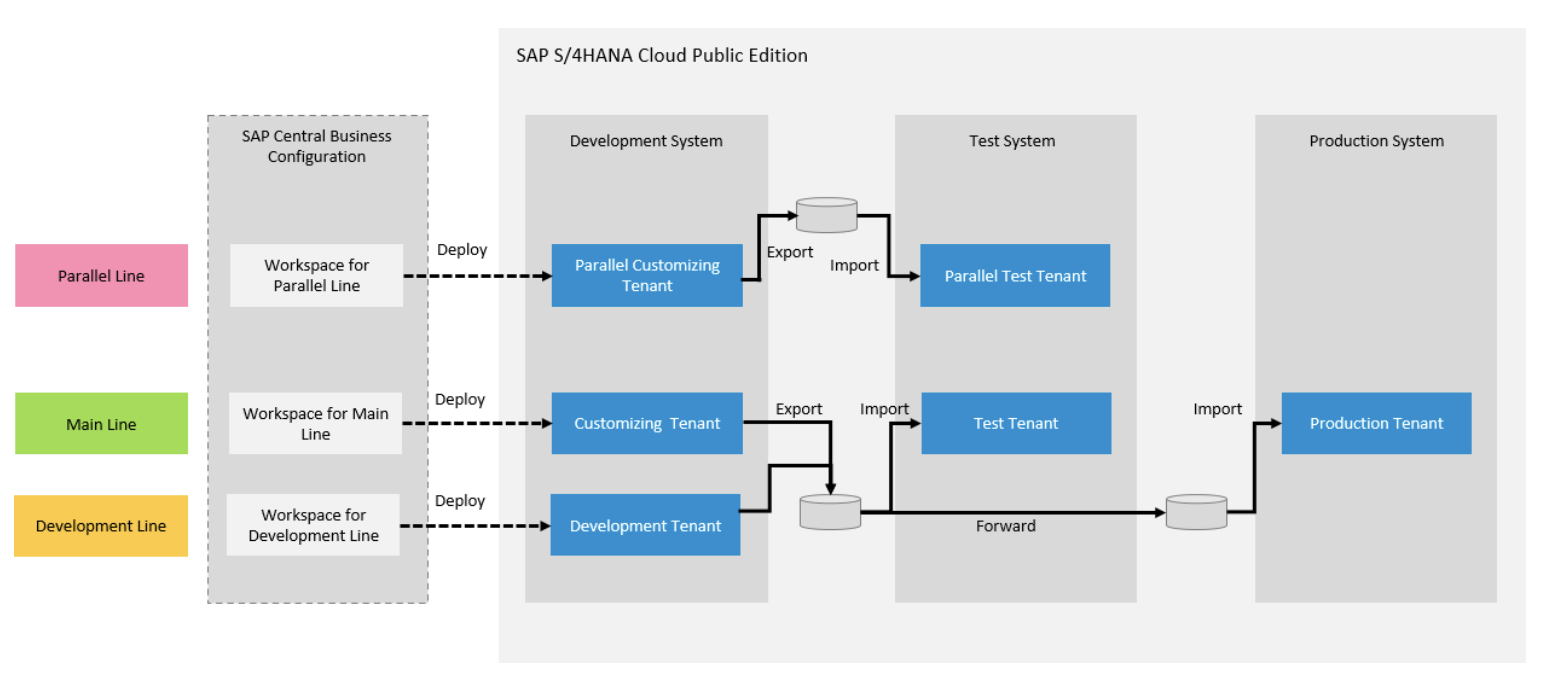
- Development System (D / Customizing Tenant)
Used for configuration (SSCUI), developer extensibility, and initial setup activities. - Test System (Q / Test Tenant)
Dedicated to integration testing, user acceptance testing (UAT), and regression validation. - Production System (P)
Live operational system where business transactions are executed.
System provisioning, tenant isolation, and lifecycle management are handled entirely by SAP.
Transport Management & Change Control
Changes are governed through centralized transport management:
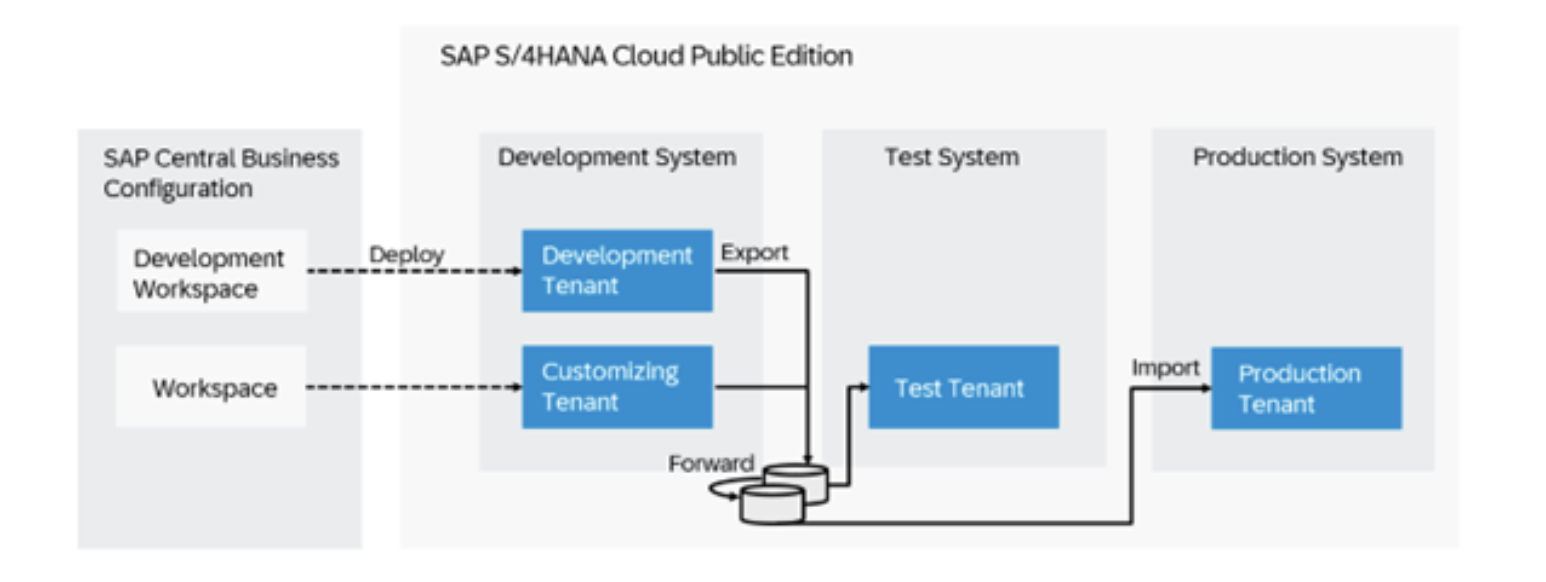
- Configuration and development objects are transported from Development → Test → Production
- Transports are controlled via SAP’s Software Collection and Transport Organizer.
- Auditability is enforced through structured release and import processes.
- No direct changes are allowed in Production (ensuring system integrity).
This eliminates the need for custom transport routes or manual intervention typical in on-premise systems.
Extensibility Within a Controlled Landscape
Extensibility in SAP S/4HANA Public Cloud is intentionally structured to preserve system integrity and enforces clean core principle while allowing controlled innovation.
The model is layered:
- Configuration (CBC / SSCUI) defines organizational structure, scope activation, core process behavior.
- In-App (Key User) Extensibility enables UI adaptation, custom fields, reporting, and form adjustments directly within the system.
- Side-by-Side Extensibility on SAP Business Technology Platform supports custom applications, integrations, and automation without impacting the core.
- Embedded ABAP allows advanced logic while remaining upgrade-compliant.
System standardization, governed transports, and structured extensibility eliminate variability and reduce operational risk.
The result is a landscape that is:
- Predictable in behavior
- Stable across releases
- Scalable without redesign
For IT leaders, the objective is not to increase complexity, but to operate within a constrained, well-defined architecture that supports continuous delivery.
A well-designed SAP S/4HANA Public Cloud landscape does not require ongoing correction. It remains aligned, upgrade-ready, and operationally efficient by design. Simplicity in landscape design is a strategic choice. Make it deliberately, make it early, and your SAP S/4HANA Public Cloud investment will perform the way it was designed to.