


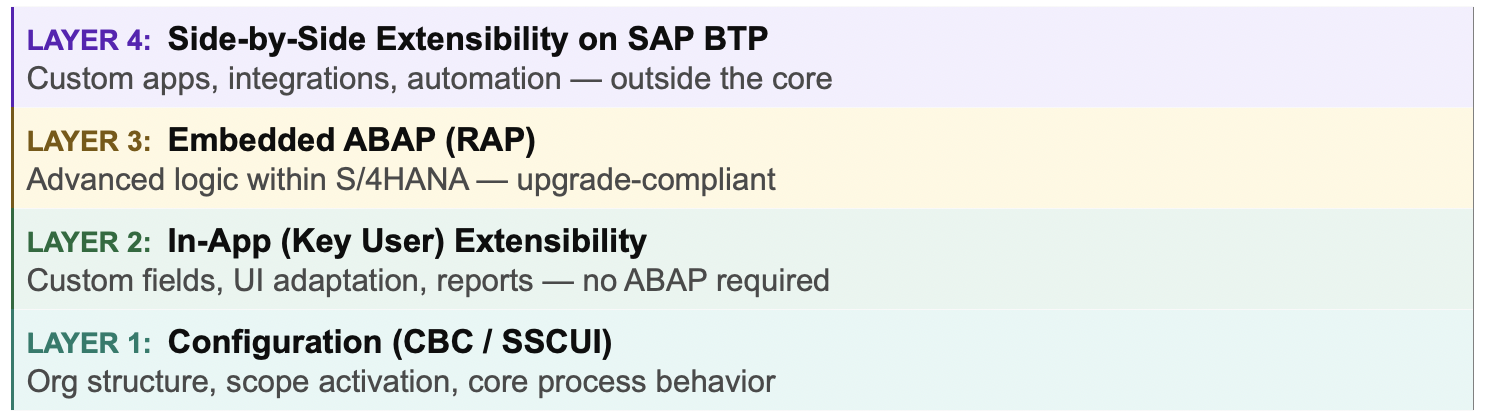
The Four-Layer Extensibility Model
Extensibility in SAP S/4HANA Public Cloud is intentionally structured to preserve the clean core principle while enabling controlled innovation at every level. Each layer serves a distinct technical purpose and requires a different skill set. The correct layer for each requirement is determined by complexity and whether it belongs inside the system or must live on BTP.
Layer 1: Configuration (CBC / SSCUI)
Configuration is the foundation of every SAP S/4HANA Public Cloud implementation. The Central Business Configuration (CBC) and Self-Service Configuration UI (SSCUI) allow functional consultants to define organizational structure, company codes, plants, sales organizations and activate process scope items, and control core process behavior without ABAP. Configuration decisions made during the Explore phase directly shape system behavior and must be completed before extensibility work begins.
Layer 2: In-App (Key User) Extensibility
In-App Extensibility is the primary customization tool for business users and functional consultants who need to adapt the system beyond standard configuration. It operates entirely within the S/4HANA system using SAP-provided tooling; no ABAP required and fully upgrade-safe.
- Custom Fields – Add customer-specific fields to standard SAP objects, visible in Fiori apps and available for custom reporting.
- Custom Logic (BAdIs) – Inject business rules at defined process extension points using a guided, no-ABAP framework.
- UI Adaptation – Rearrange, hide, or relabel Fiori app fields using SAPUI5 Adaptation Editor. Offering personalization per business role.
- Custom Analytical Queries – Build bespoke KPI tiles and list reports using the Custom Analytical Queries app, no BW or ABAP needed.
- Form and Output Adaptation – Modify standard output forms (invoices, purchase orders) using Form Template Maintenance.
Layer 3: Embedded ABAP (RAP)
For requirements exceeding key user tools but that still belong inside the S/4HANA system — SAP provides the RESTful ABAP Programming Model (RAP). RAP allows ABAP developers to build custom Fiori apps, OData services, and business logic that are upgrade compliant. RAP-based developments use only SAP’s released APIs and follow clean-core conventions; no modification of standard SAP objects.
Embedded ABAP with RAP is the bridge between simple key user customization and full BTP-side development. Use it when the logic is complex, requires HANA database access, and must remain tightly integrated with the S/4HANA data model.
|
The three in-system extensibility layers: Configuration, In-App Key User tools, and Embedded ABAP cover the majority of customization requirements in a well-scoped SAP S/4HANA Public Cloud implementation. Organizations that fully leverage these layers before escalating to BTP control their BTP consumption costs and keep their extension portfolio maintainable. The governance rule: use the lowest layer that technically satisfies the requirement.