

SAP S/4HANA Cloud Public Edition handles your core business data, financial records, procurement transactions, supply chain movements. The technical system landscape is designed from the ground up so that every connection point whether a business user accessing the system or a remote system integrating with it operates under enforced security controls.
The Technical System Landscape Overview
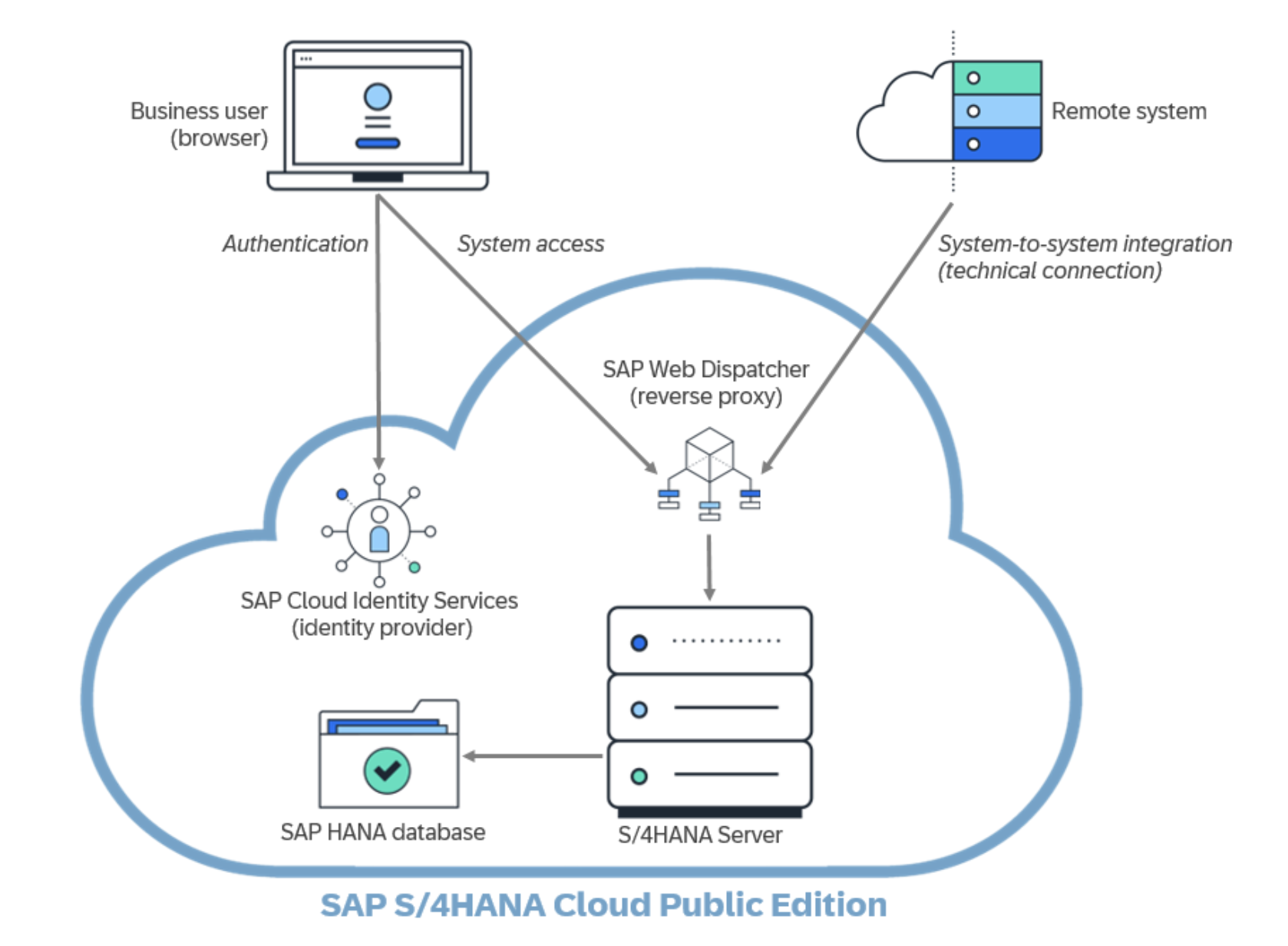
SAP is committed to the highest security and quality requirements for SAP S/4HANA Cloud Public Edition. The following technical controls are implemented at the platform level and apply to all customers without exception:
- Business data is stored in SAP-operated data centers reflecting the highest security standards.
- Data residing in the SAP HANA database is encrypted at rest using state-of-the-art encryption keys AES-256 at the database layer.
- Each customer is issued a unique, customer-specific URL. No two customers share an access endpoint.
- System access from any network occurs exclusively over encrypted HTTPS/TLS communication using open cryptographic standards. All data in transit is encrypted at all times.
- All inbound communication is routed through the SAP Web Dispatcher; a reverse proxy component developed, operated, and maintained by SAP before it reaches the S/4HANA Server.
- Customers may share physical hardware infrastructure, but all data is strictly separated into logical, isolated tenants. No customer can access another customer’s data.
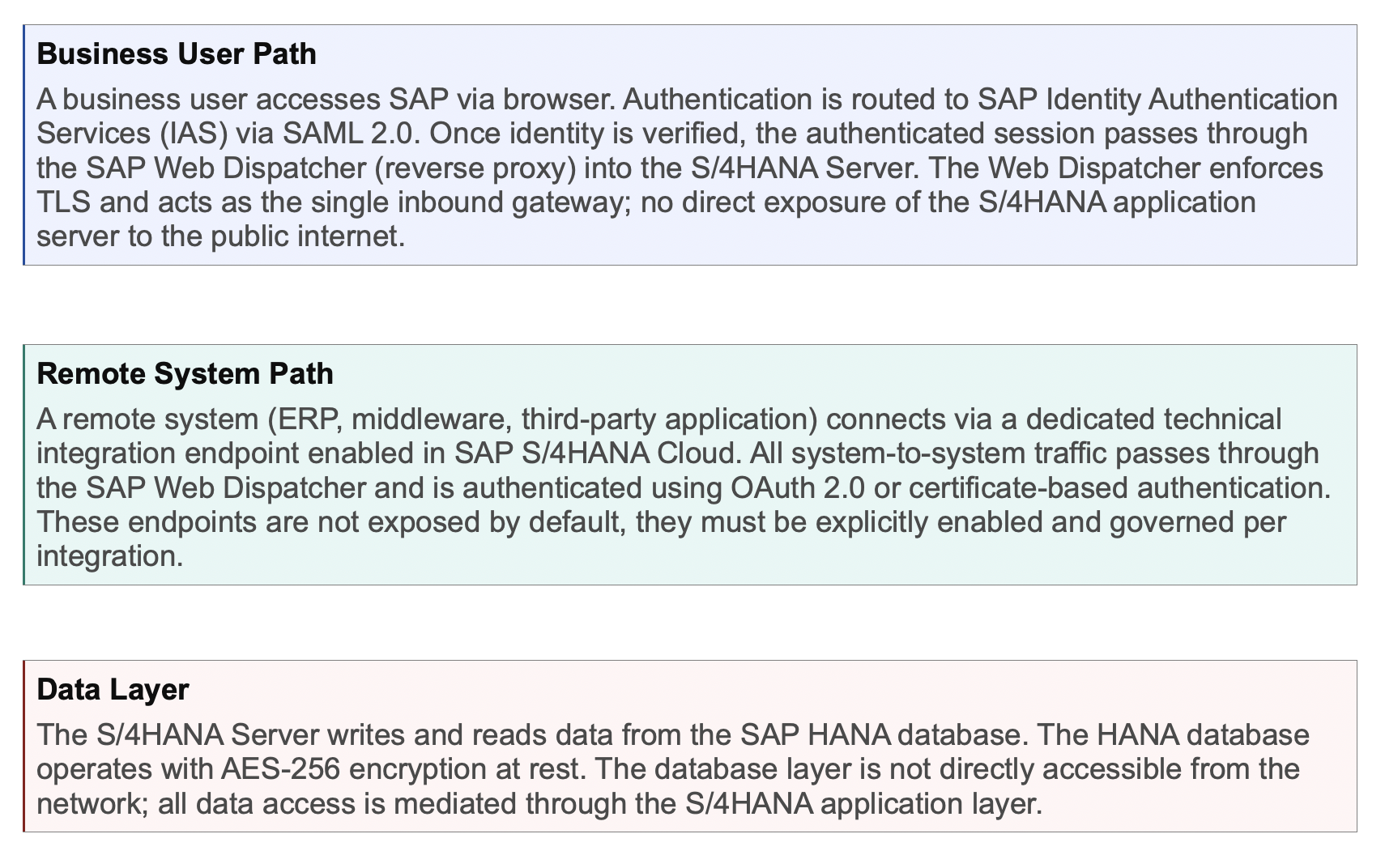
- Users requiring access to business data must authenticate themselves. Authentication for business users is always performed via SAML 2.0 assertions, enforced by SAP Identity Authentication Services (IAS).
- For system-to-system integration, dedicated technical endpoints can be enabled in SAP S/4HANA Cloud Public Edition, supporting controlled remote system access.
Reading the Architecture Diagram
The technical system landscape of SAP S/4HANA Cloud Public Edition is not a generic cloud deployment. Every connection path, user access, system integration, data storage operates under platform-enforced security controls designed to meet enterprise-grade and regulatory requirements. For IT architects and security teams evaluating Public Cloud adoption, this architecture means the platform security baseline is defined, audited, and maintained by SAP. Your security investment focuses on configuring and governing the identity, integration, and access layers that sit on top of it.